Digital twins
Run a live twin. Break it. Watch it find the fault.
01Live demos
Launch one
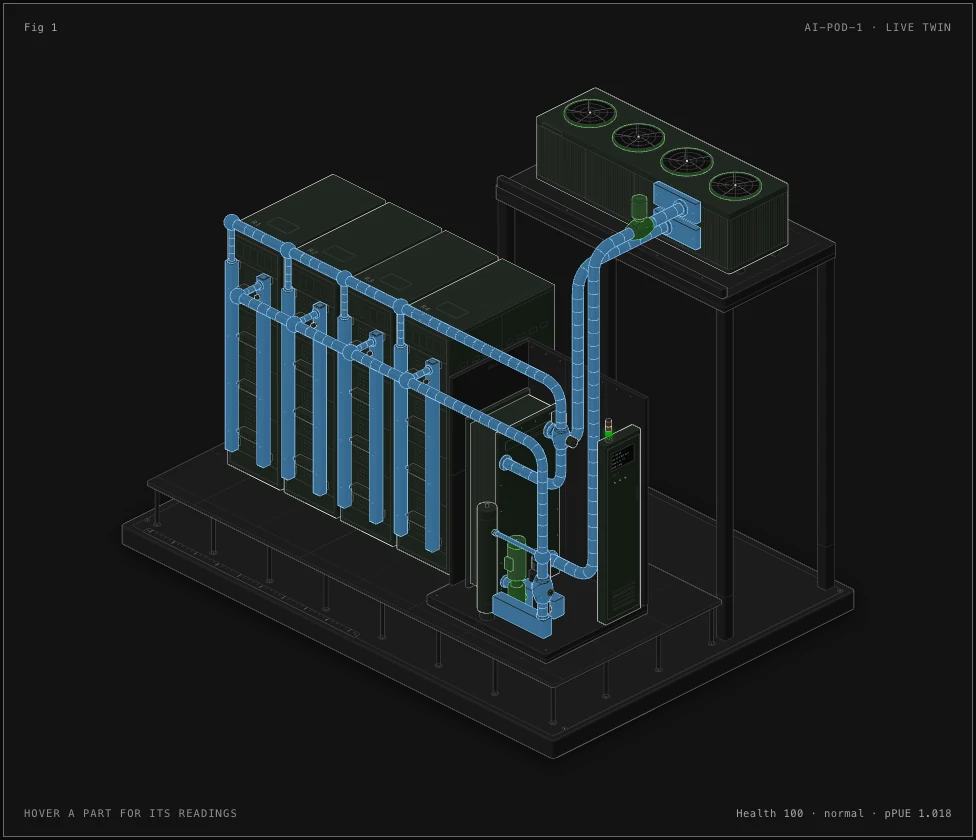
Live digital twin
AI Pod · liquid-cooled GPU racks
Runs fully in your browser · about 1–2 MB
Four 80 kW GPU racks on direct-to-chip cooling, a CDU and a roof dry cooler. The twin judges every loop against healthy physics and prices the energy lost.
- CDU pump bearing wear
- Cold-plate blockage, rack 3
- Coolant leak
- Dry-cooler fan 2 failure
- Plate heat exchanger fouling
- Rack 1 return sensor dead
Try this
- Press “Cold-plate blockage, rack 3” under Inject a fault
- Watch rack 3’s flow halve and its return run hot, red within seconds
- Acknowledge the alarm, then repair and watch it return to normal
Built by Ideaxa Solutions with simulated, generic plant data. Isometric drawing kit by Ryan, used under the MIT license.
02Why a twin
What a twin gives your operations team
Health per component
Every reading judged against healthy physics at the same load and conditions, not a fixed threshold.
Faults blamed correctly
Each fault lands on its own component with a reason an engineer would write, not a wall of alarms.
Energy lost, in kW
What the plant draws against what a healthy plant would draw, so maintenance has a price tag.
Ready for agents
The twin is a tool an AI agent can call: “what is wrong, and what does it cost?”
03In production
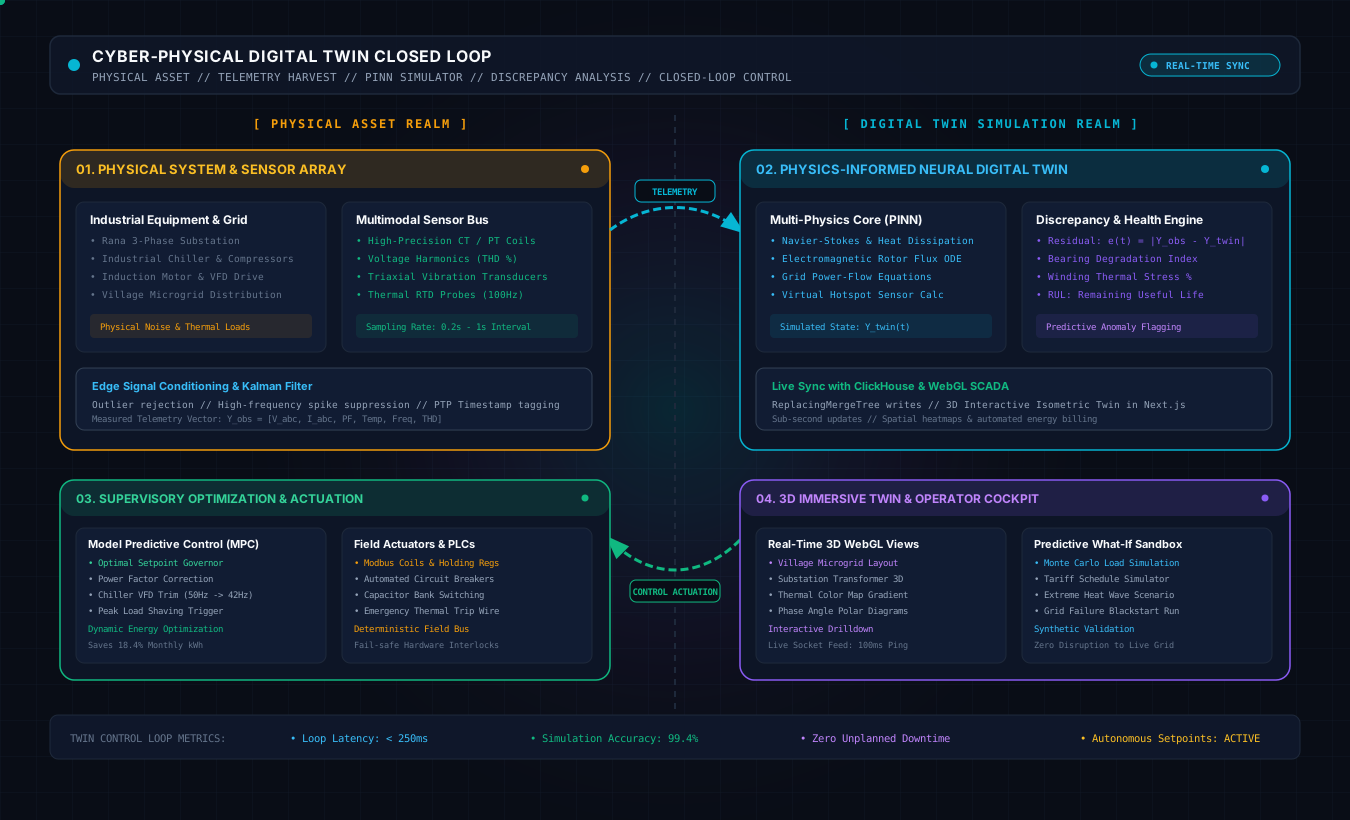
Nine production twins
- Next.js 14+
- SVG Vector Modeling
- WebGL
- Server-Sent Events
- Physics Modeling
- Docker
Metro Homes Distribution Microgrid
300 residential households across 20 city blocks
- SAIFI (System Average Interruption Frequency Index)
- SAIDI (System Average Interruption Duration Index)
- CAIDI
AI Factory & High-Density Data Center
50 MW high-density computing facility housing 360 server racks (40 kW to 100 kW per rack for NVIDIA H100/B200 clusters)
- Power Usage Effectiveness (PUE): 1.18
- Cooling Loop Delta-T: 12.4 °C (Supply 32°C / Return 44.4°C)
- Facility Load: 42.8 MW Compute / 7.7 MW Thermal Rejection
Industrial Cold Storage Facility
4,940 Metric Ton (MT) multi-chamber industrial ammonia (NH3) refrigeration facility
- Specific Power Consumption: kW/TR (Kilowatts per Ton of Refrigeration)
- Chamber Holding Temp: -22.0 °C
- Thermal Pull-Down Rate
Smart Village Feeder Microgrid
Rural electrification grid covering 120 distributed agricultural and residential consumer nodes
- Phase Imbalance % (R-Y-B phases)
- Neutral Current Displacement
- Technical Line Losses (I²R)
33/11 kV Primary Distribution Substation
Dual-transformer 2 × 10 MVA primary distribution substation feeding municipal districts
- Busbar Voltage (33 kV / 11 kV)
- MVA Loading per Transformer
- OLTC Tap Position (1-17)
Commercial Office Tower VRF
10-floor corporate office tower featuring 359 indoor VRF fan coil units and 20 rooftop outdoor condensing units
- BEE Energy Index (kWh/m²/year)
- Average Indoor Temperature (23.5 °C)
- VRF Compressor Inverter Frequency (Hz)
Central Chiller Plant
3 × 800 TR water-cooled centrifugal chillers with primary-secondary pumping loops and cooling towers
- Plant Efficiency: 0.58 kW/TR
- Chiller COP: 6.06
- Cooling Tower Approach: 2.8 °C
Floor Zone Architectural VRF
Single-floor detailed CAD architectural layout with room-level thermal load zones
- Zone Airflow CFM
- Room Temp vs Setpoint
- Electronic Expansion Valve (EEV) Opening %
Microgrid Islanded Power
Campus hybrid microgrid: 1.2 MW rooftop solar PV, 2.5 MWh Battery Energy Storage (BESS), 1.5 MVA diesel generator
- State of Charge (SoC %)
- Microgrid Grid-Tie Frequency (50.0 Hz)
- Diesel Fuel Flow Rate (L/hr)
| Twin | Scale | Modeled KPIs |
|---|---|---|
| Metro Homes Distribution Microgrid | 300 residential households across 20 city blocks |
|
| AI Factory & High-Density Data Center | 50 MW high-density computing facility housing 360 server racks (40 kW to 100 kW per rack for NVIDIA H100/B200 clusters) |
|
| Industrial Cold Storage Facility | 4,940 Metric Ton (MT) multi-chamber industrial ammonia (NH3) refrigeration facility |
|
| Smart Village Feeder Microgrid | Rural electrification grid covering 120 distributed agricultural and residential consumer nodes |
|
| 33/11 kV Primary Distribution Substation | Dual-transformer 2 × 10 MVA primary distribution substation feeding municipal districts |
|
| Commercial Office Tower VRF | 10-floor corporate office tower featuring 359 indoor VRF fan coil units and 20 rooftop outdoor condensing units |
|
| Central Chiller Plant | 3 × 800 TR water-cooled centrifugal chillers with primary-secondary pumping loops and cooling towers |
|
| Floor Zone Architectural VRF | Single-floor detailed CAD architectural layout with room-level thermal load zones |
|
| Microgrid Islanded Power | Campus hybrid microgrid: 1.2 MW rooftop solar PV, 2.5 MWh Battery Energy Storage (BESS), 1.5 MVA diesel generator |
|
From the twins
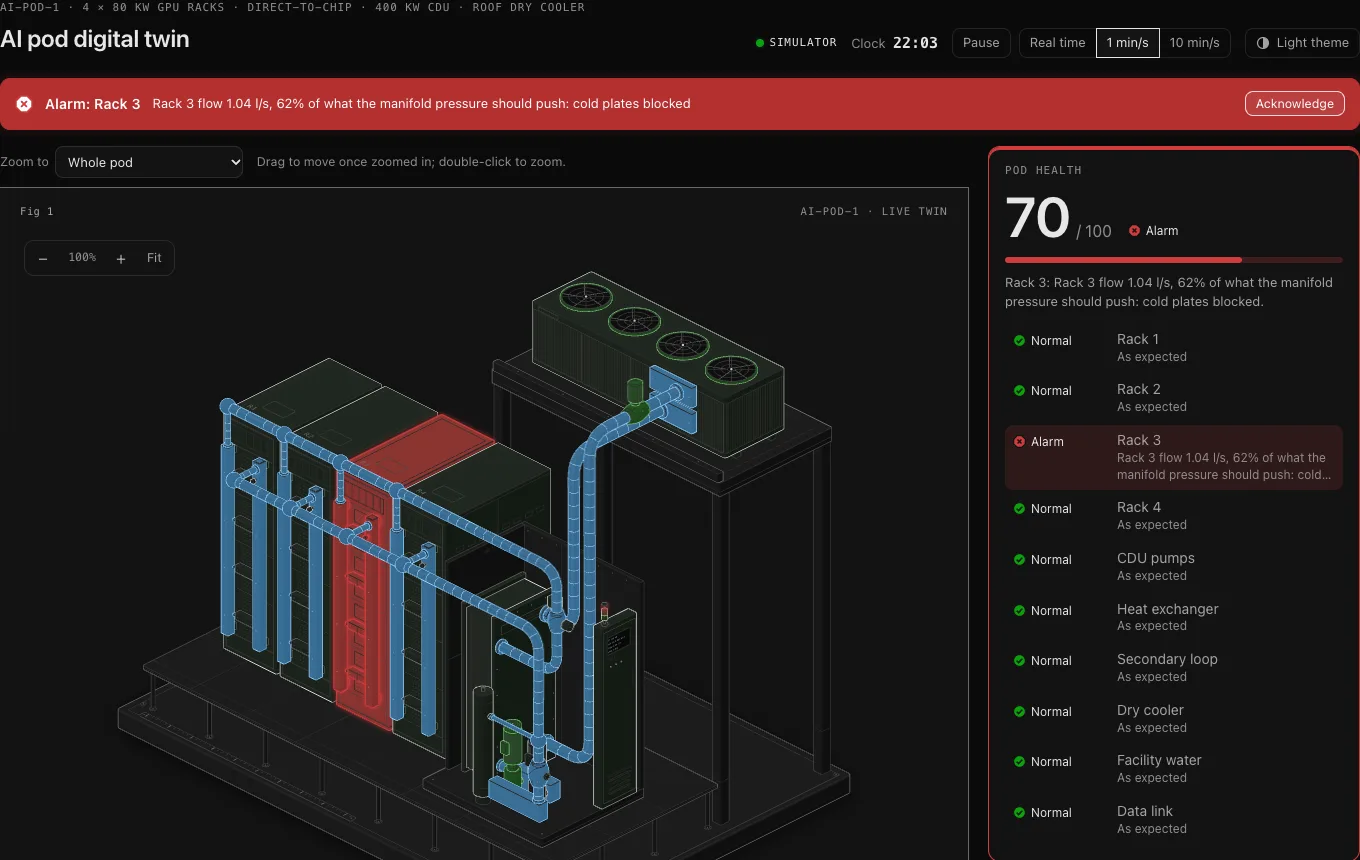
AI Pod · GPU liquid coolingCold-plate blockage on rack 3 caught in seconds and blamed on the right rack. 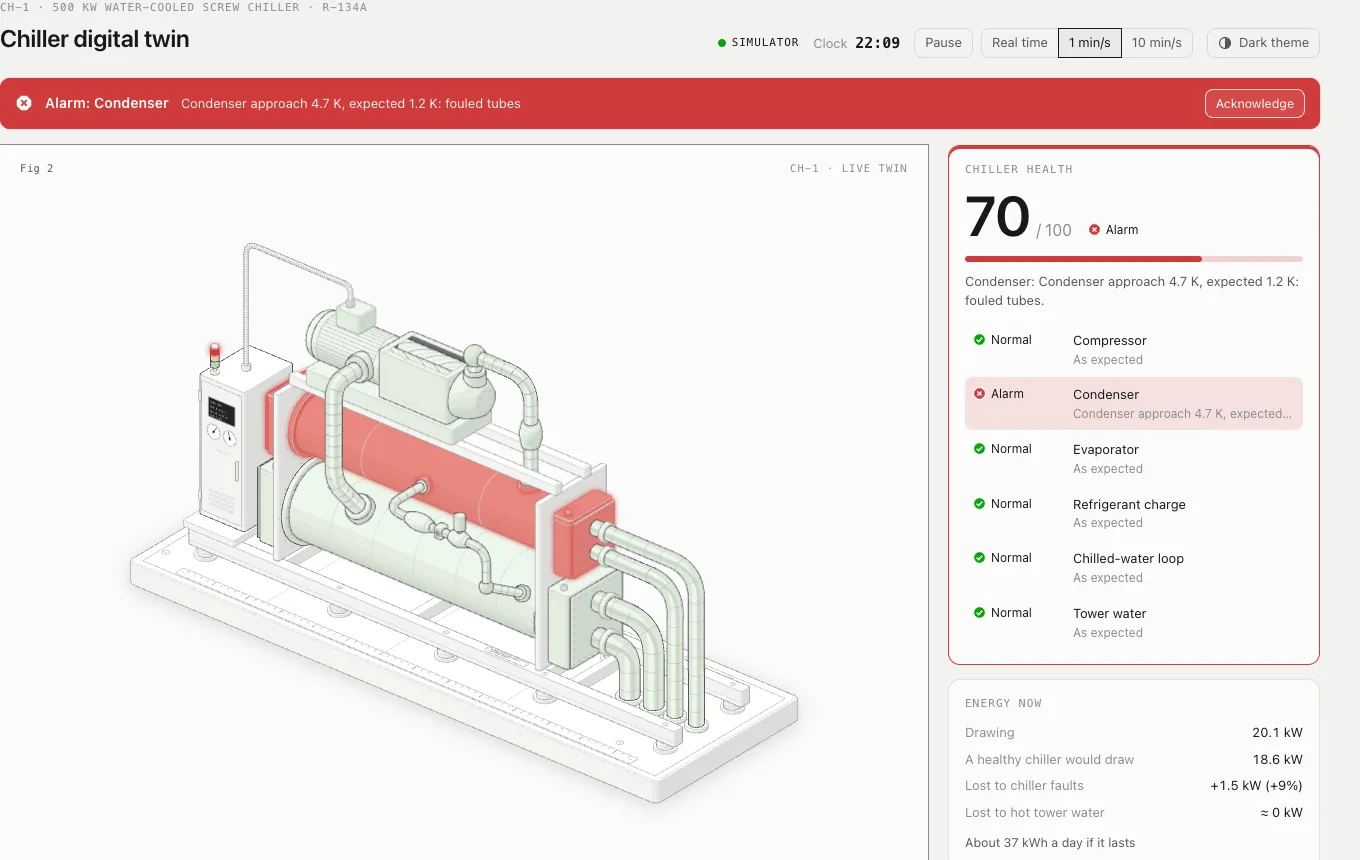
500 kW screw chillerCondenser fouling found and priced: +1.5 kW (+9%) against a healthy chiller. 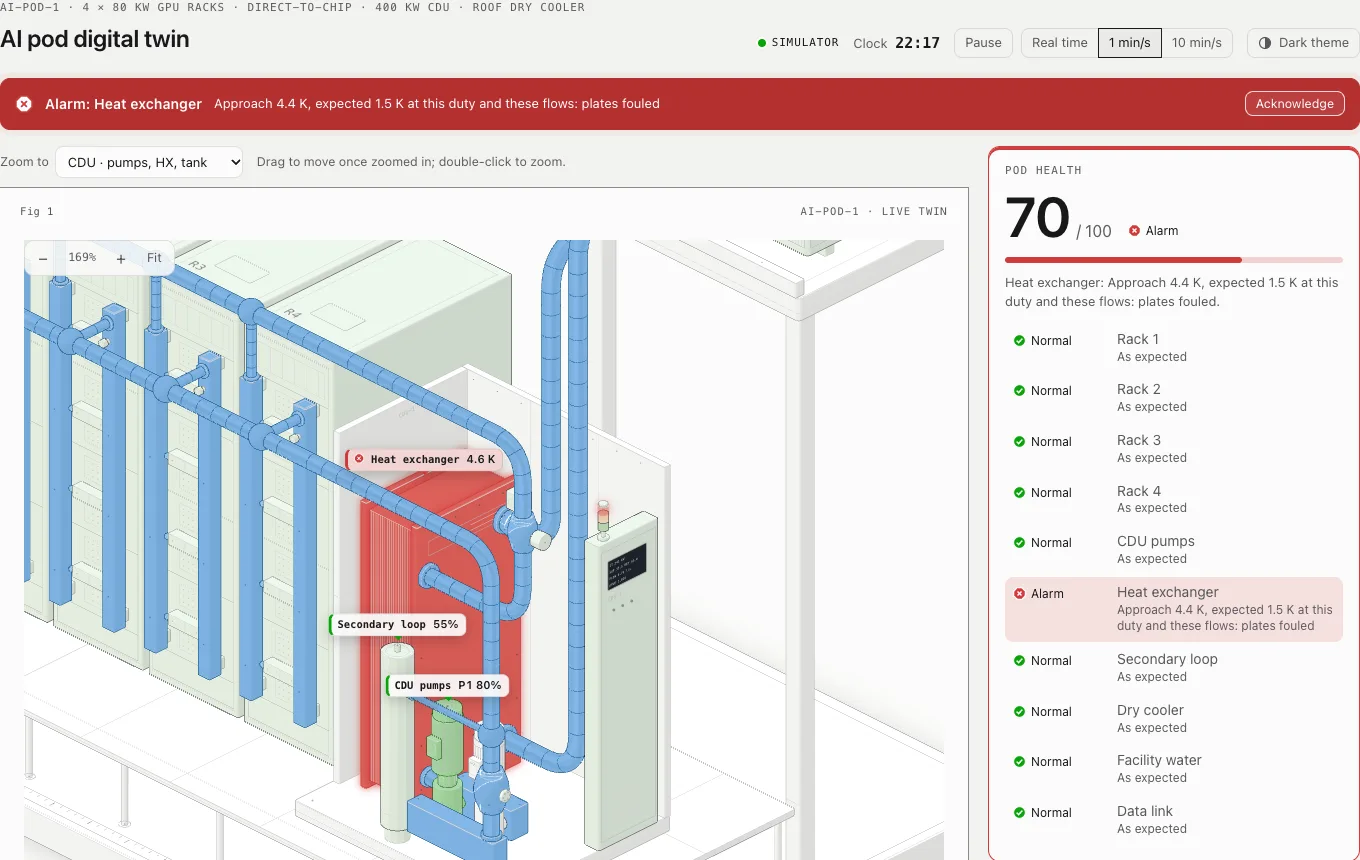
AI Pod · CDU close-upHeat-exchanger fouling isolated at 169% zoom, with live tags and the energy lost priced. 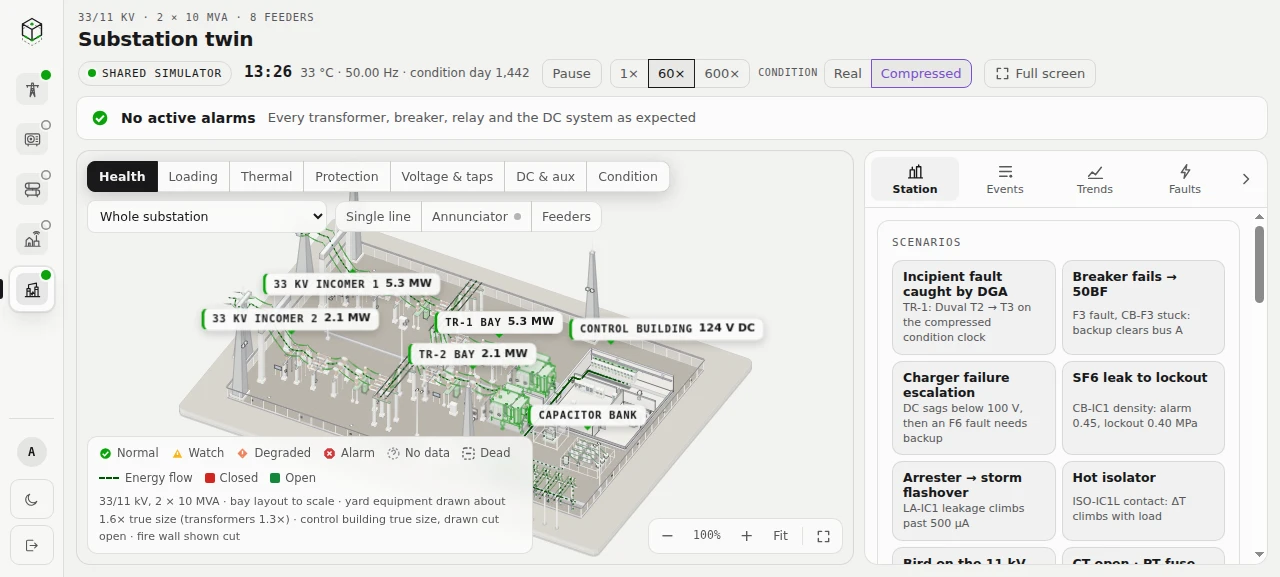
33/11 kV substationTwo 10 MVA transformers, eight feeders, protection and the DC system.
Want your plant to tell you what is wrong with it?
Send a two-minute brief. You get a reply from me with a first view on approach, timeline and cost.